


Beyond UFOs by Jeffrey Bennett
Home About Excerpts Reviews and Comments Events Blog

BlogPrimer

A Global Warming Primer
Jeffrey Bennett
Original posting: March 2007

Note: All figures below are from my textbooks and based on published scientific data.

Most misconceptions about global warning surround confusion over what is "certain" and "uncertain" in the science behind it. Some parts of the science are indeed uncertain, but others are not. To clarify which is which, here are four questions that everyone should ask (and be able to answer) about global warming:

Question 1: The basic claim of global warming is that a higher atmospheric concentration of carbon dioxide will make Earth warmer. Is there any doubt that, all other things being equal, higher carbon dioxide concentrations do indeed make planets warmer?

Answer: No. Carbon dioxide and other "greenhouse gases" (including water vapor and methane) are molecules that absorb infrared light and thereby cause what is known as the greenhouse effect; for those who are interested, the figure below shows the basic mechanism. The greenhouse effect is so well understood that you will not find any scientists who dispute it. Indeed, the greenhouse effect occurs naturally on Earth, and that turns out to be a very good thing: Without it, Earth would be far too cold for liquid water or life. Studies of other planets show that the greenhouse effect can be even more important in determining a planet's surface temperature than the planet's distance from the Sun. Venus provides the most extreme example: Although Venus is closer to the Sun than Earth, its clouds are so reflective that less sunlight reaches Venus's surface than Earth's surface. As a result, without the greenhouse effect, Venus would be colder than Earth. But because Venus has a thick atmosphere containing far more carbon dioxide than Earth's atmosphere (by a factor of about 170,000), Venus's actual surface temperature is a searing 870°F. Given that the naturally occurring greenhouse effect is a good thing for life on Earth, Venus offers proof that it's possible to have too much of a good thing.

Caption.This diagram shows the basic mechanism of the greenhouse effect. Earth's surface absorbs energy from visible sunlight, and returns this energy to space in the form of infrared light. Greenhouse gases (such as carbon dioxide and water vapor) slow the escape of the infrared light, thereby keeping the surface and lower atmosphere warmer than it would be otherwise.

Question 2: Is there any doubt that human activity has been raising the carbon dioxide concentration of Earth's atmosphere?

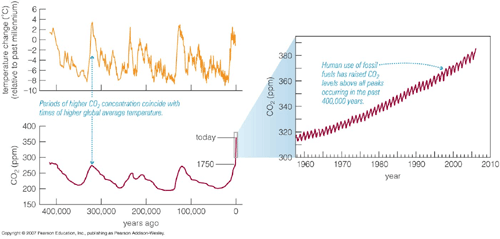
Answer: No. Scientists have directly measured the atmospheric carbon dioxide concentration since 1958 (right side of figure below), and in just these past 50 years it has risen steadily from about 315 to 380 parts per million (ppm). Concentrations from longer ago can be measured through records preserved in such things as tree rings (data to thousands of years ago) and ice cores (data to a million or more years ago). These data show that the carbon dioxide concentration undergoes substantial natural variations, but until the industrial revolution it never rose above 300 ppm during the past million years (left side of figure below shows data going back 400,000 years). In other words, we've already raised the carbon dioxide concentration more than 25% above its natural peak for the prior million years, and it's rapidly moving higher.

Caption.This diagram shows the atmospheric concentration of carbon dioxide and global average temperature over the past 400,000 years. The data at right from the past half-century come from direct measurements at Mauna Loa. Earlier data come from sources such as Antarctic ice cores. Additional data, not shown, extend the record back to about 1 million years ago.

Question 3: Is there any doubt that Earth has been warming up during the past century?

Answer: Not any more. For awhile, there were questions concerning whether temperature data were being analyzed correctly, but those doubts have been almost entirely dispelled (see the second and third items in the "postscript" section below). Since the dawn of the space age, we've had satellite data from which to make measurements of Earth's global average temperature. Data from earlier times were local rather than global, which means there are greater uncertainties in converting them to a global average. However, by studying a great variety of data sources (ranging from newspaper temperature reports to natural records like those in tree rings), the uncertainties have been reduced enough to make the trend quite clear. The graph below shows the results: The global average temperature has increased about 0.8°C (1.4°F) in the past century, and the warming appears to be accelerating during recent decades.
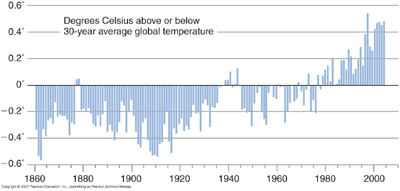
Caption.This graph shows changes in Earth's global average temperature (in Celsius degrees) since 1860; the zero line is the average for the years 1961-1990. Uncertainties are not shown, but range from about 0.3°C for the earliest years (left) to less than 0.1°C for recent years. Based on data from NOAA.

Question 4: OK, so there's no doubt that carbon dioxide raises a planet's temperature, that we're increasing Earth's carbon dioxide concentration, and that Earth is already showing signs of warming. Then what is uncertain about the science of global warming?

Answer: The uncertainty concerns the timing and the precise nature of the consequences of global warming. Earth's climate has numerous complexities and feedbacks that could alleviate, moderate, or exacerbate the consequences of global warming over the next few decades to centuries. It is this uncertainty that has provided room for a small number of scientists (and a larger number of non-scientists) to question the general consensus that we should be taking immediate steps to reduce global warming. Remember, however, that even among the very few scientists who count themselves as "global warming skeptics," there is no dispute that significant warming would eventually occur. It's just that they think we can safely wait for new technologies rather than taking expensive action now. From my perspective, this is rather like having a doctor tell you not to worry about quitting smoking, since we may find a cure for lung cancer before you die from it.

With that, you can now understand the nature of the IPCC report. It is not a report about whether the basic science of global warming is real - there's no doubt about that. Rather, it is a report about attempts to predict the short-term (decades to centuries) consequences of global warming. In essence, hundreds of the world's leading climate scientists got together to sift through research conducted by thousands of their colleagues, in an attempt to consolidate all this research into one "best estimate" of the problem we face. This best estimate could certainly be overstating the short-term problem (as the "global warming skeptics" argue), but it could also be understating it. Personally, I suspect that it is understating the consequences in at least one critical area: sea level rise. The report predicts only a modest rise in sea level (though still bad news for the vast numbers of people living in low-lying coastal areas), but in making this prediction the IPCC scientists decided not to take into account recent data showing an unexpectedly rapid melting of polar glaciers (especially in Greenland; see figure below). If these new data hold up to further scrutiny (and I think they will), the expected sea level rise will be much more significant. And while even at this accelerated rate it would probably take many centuries to melt all polar ice, remember this fact: Melting of the Greenland ice sheet would raise sea level about 20 feet, and melting of the Antarctic ice sheet would raise sea level more than 200 feet. Are you willing to risk setting our planet on a course where future generations will need deep-sea diving gear to visit places like New York City and San Diego?
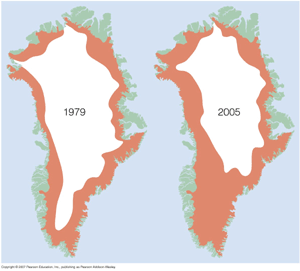
Caption.Evidence of a surprisingly rapid loss of glacial ice. These maps contrast the extent of the year-round Greenland ice sheet, shown in white, in 1979 and 2005. The orange area indicates the region that melts during the warm seasons. Note that the melt region has expanded significantly, extending both further inland (to higher elevations) and further north.

So there you have it. There's really very little uncertainty surrounding the entire global warming issue, and what little there is concerns only whether we need to worry immediately or if we can afford to wait a few decades. My opinion is that we cannot afford to wait, because the risks are simply too great. To help you make up your own mind, I suggest that you take the "letter to your grandchildren test": Imagine writing (or actually write one!) a letter that will be placed in a time capsule for your children or grandchildren to read in 50 years, telling them what you did to help alleviate global warming, or why you decided that no action was required. Then ask yourself: How will they feel about the decisions you made?


Postscript

Since you will surely encounter them on the news, I suppose I should also address the small but vocal group of people who go around claiming that global warming is some kind of hoax. Like those who claim NASA never landed on the Moon or that the Grand Canyon proves Earth is only 6,000 years old, the best way to combat these folks is to understand the flaws in their claims. I can't go into all of the arguments here, but to start with you should realize that most of their "facts" are at best distortions and at worst outright lies. Here's a few examples:

  • Many in the "it's a hoax" camp are now claiming that back in the 1970's the scientific consensus was that we were headed for global cooling and an ice age - a "fact" they use to support their claim that you shouldn't believe the scientific consensus today. However, this "fact" simply isn't true. Perhaps the people stating this untrue "fact" are just confused, since by the '70s we had learned that we are currently in an "interglacial" period following the last ice age (suggesting that we might be "due" for another ice age) and data showed (and still do) a slight global cooling during the mid-20th century. But with a few exceptions, scientists already recognized this cooling as an aberration, unrelated to long-term ice age cycles, and that the real issue for the future would be global warming. I know this from my own experience, since my '70s science classes were already discussing global warming as the serious concern. If you want more proof, just look back at scientific publications from the 1970s. There are many examples, but here's one to start with: The summary of an article published in Science Magazine, 8 August 1975, p. 460, states: "...the exponential rise in the atmospheric carbon dioxide content will tend to become a significant factor and by early in the next century will have driven the mean planetary temperature beyond the limits experienced during the last 1000 years."
  • The "hoax" camp has made a mini-industry of claiming that the "hockey stick graph" - a graph of data showing that global temperatures are now higher than at any time in the past thousand years - has been discredited (a recent Wall Street Journal editorial said this directly). However, while the original methodology that led to this graph was indeed criticized by some scientists, its basic data and conclusions have since been validated. Indeed, based on a request from Congress, the National Research Council (NRC) investigated the "hockey stick" graph. The NRC report on the issue, published in 2006, came out in strong support of the methodologies used to look at past climate data and of the conclusion that temperatures now are certainly higher than at any time in the past 400 years and likely higher than anytime in the past 1,000 years. (You can read the NRC report summary or order the full report here.) Bottom line: Those who claim that the graph has been discredited are ignoring reality.
  • Some of the same folks are still recycling another old claim - that satellite data about atmospheric temperatures contradict data showing that Earth is warming; again, there was once some controversy over these data, but the apparent discrepancy has now been resolved (in essence, the discrepancy was traced to errors in the data calibration, and once those were understood the discrepancy went away). For a summary of how both scientific sides came to agreement this issue, see Science Magazine, 12 May 2006, p. 825.
  • Another popular claim in the hoax camp is that the IPCC report is flawed because "science is not done by consensus." While it is true that science must be based on evidence rather than on votes, it is also still the case that science progresses only when the evidence becomes strong enough to lead to widespread acceptance in the scientific community. For example, Einstein's theories might have died a quick death if not for the fact that evidence in support of them soon convinced the vast majority of scientists. Indeed, when people ask me for a brief statement on the purpose of science, I like to say that science is a way of examining evidence so that people can come to agreement. The IPCC report is just that: a large group of scientists who examined the evidence and came to agreement.
  • Finally, for an extreme example of the lengths to which some people will go to dispute something that is really indisputable, here's a quote from Rush Limbaugh (complete transcript here.): "I'm not a scientist - in my common man way, I explained to this caller why I do not believe in global warming. I gave as my primary belief that I believe in God.... I'm saying as a believer of a loving God and a God of Creation, that there is a complexity to all this that makes it work; that we cannot understand; that we cannot really control; that we cannot destroy, and that we really can't alter in its massive complexity." So there you have it: If you believe that God has set things up so that it's impossible for us to do anything bad to our planet, then you have nothing at all to worry about. But if you believe that God gave us free choice and helps those who help themselves, then we'd better get to work.

Just for fun, here is what planetary scientist (and co-author of my astronomy texts) Nick Schneider calls "the four levels of denial" for global warming:

Level 1: "The Earth is not warming up." (denying the data)
Level 2: "It's warming up, but it's natural." (denying the cause)
Level 3: "It's warming up, humans are causing it, but it's actually beneficial." (denying the consequences)
Level 4: "It's warming up, humans are causing it, it's harmful, but it's too expensive to solve." (denying responsibility)

Don't you think it's time to get out of denial?

---Jeffrey Bennett